


ESG Governance in the SBF 120: Beneath Apparent Uniformity, Uneven Maturities.
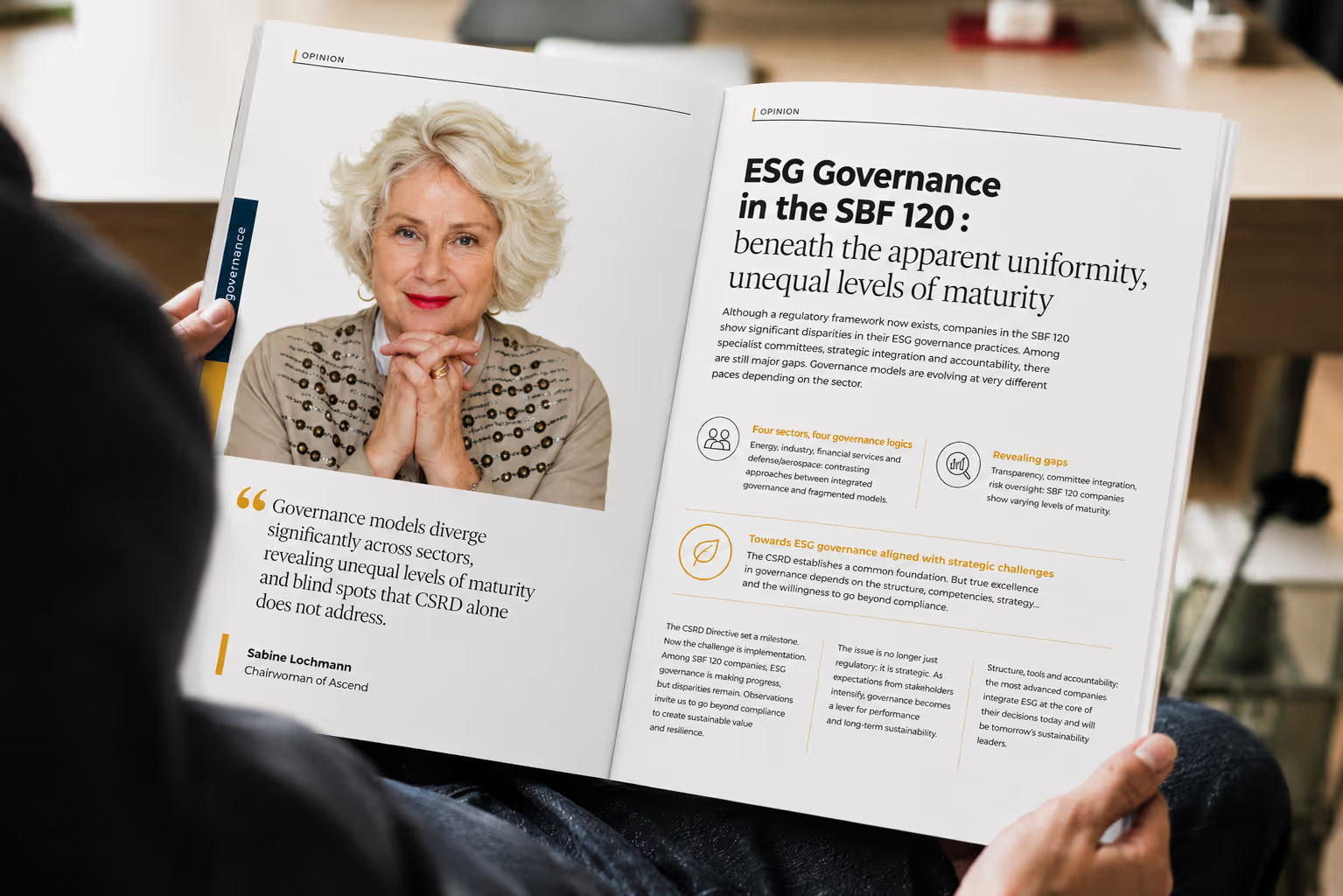
This article by Sabine Lochmann analyzes the ESG governance models of SBF 120 companies and the highly uneven levels of maturity they reveal across sectors. It was published in May 2026 in issue no. 25 of NextStep magazine, edited by La Lettre des Juristes d'Affaires (LJA).
Temps de lecture estimé : X min


86% of SBF 120 boards have an ESG committee. 95% of executives are compensated based on non-financial criteria. The figures give an impression of uniformity, but this is misleading.
Beneath the surface of shared formal compliance, governance models diverge significantly across sectors, revealing uneven levels of maturity and blind spots that the CSRD alone does not address.
Key regulatory framework: ESRS 2 and AFEP-MEDEF Code
ESRS 2 Governance Requirements
ESRS 2, the only mandatory cross-cutting standard for all companies subject to the CSRD, regardless of their materiality assessment, outlines four specific governance disclosure points:
- GOV-1 : Composition, roles, and competencies of administrative, management, and supervisory bodies regarding sustainability,
- GOV-2 : Information flow to these bodies (frequency, nature, responsible party),
- GOV-3 : Integration of sustainability performance into incentive mechanisms (variable compensation),
- GOV-4 : Statement on due diligence (due diligence),
- GOV-5 : Risk management and internal controls related to sustainability information.
These requirements compel companies to document not only the existence of committees, but also the reality of the decision-making process : who receives what, how often, and with what follow-up. The audit committee is assigned an expanded role in overseeing the quality of non-financial reporting.
Anchoring in the revised AFEP-MEDEF code
The December 2022 revision of the AFEP-MEDEF code, whose new recommendations apply to general meetings reviewing financial years beginning on or after January 1, 2023, has deliberately placed CSR strategy at the core of the board's responsibilities. It notably recommends:
- The board's definition, upon proposal by general management, of multi-year strategic guidelines on CSR, outlining an action plan with time horizons,
- Regarding climate matters, quantified objectives at different horizons, presented to the general meeting at least every three years,
- The establishment of a specialized committee responsible for preparatory work on CSR topics, without imposing a single architecture,
- The publication of the detailed composition of the committees and the frequency of their meetings.
The AMF annually supervises the quality of these publications and published in 2025 a review report covering 91 assurance reports from the CAC 40 and SBF 120, highlighting that the transition remains "unfinished" despite real structuring efforts.
Four sectors, four governance approaches
Model 1: the merged Strategy & CSR committee (energy)
TotalEnergies embodies the most integrated model: a committee which meets 3 times a year, with an attendance rate of 88.9%. This committee simultaneously handles capital allocation decisions between hydrocarbons and renewable energies, as well as transition issues. The merger of strategic and CSR dimensions is a deliberate choice so that investment decisions are considered through the same lens. The Audit Committee has been entrusted with new missions stemming from the CSRD regulation related to the publication of sustainability information. All members of the audit committee underwent an external training dedicated to CSRD issues, in which most Board members also participated.
ENGIE, for its part, operates via its Committee for Ethics, Environment and Sustainable Development (CEEDD) within the board of directors, as well as through a Group Management Committee. In September 2024, directors received specific training on CSRD, covering the entire ESG spectrum. ENGIE published its first CSRD-compliant sustainability statement in 2025.
Model 2: Articulated Thematic Committees (multi-sector industry)
Bouygues illustrates the three-committee architecture in interaction: the Ethics, CSR and Sponsorship Committee, which monitors extra-financial performance and proposes the ESG components of the strategy (with joint sessions with the Governance Committee to calibrate CSR objectives integrated into remuneration); the Audit Committee, which oversees the quality of the sustainability reporting process and sustainability auditors; the Governance, Selection and Remuneration Committee, which develops remuneration policies including ESG criteria. All board members state that they feel sufficiently trained on sustainability topics, with training sessions including the Climate Fresk, CSRD regulations, and energy/economy issues having been organized since 2021.
Schneider Electric for its part, adopts a five-committee architecture:
- Governance, Nominations & Sustainability Committee,
- Audit & Risk Committee,
- Human Capital & Remuneration Committee,
- Investment Committee,
- Digital Committee.
This diversification reflects the systemic integration of sustainability: the Governance, Nominations & Sustainability Committee anchors it in the director recruitment and nomination policy. Schneider Electric was named the world's most sustainable company in 2025 by Corporate Knights, a sign of its highly advanced ESG maturity among SBF 120 companies.
Model 3: the strengthened Strategic and CSR Committee (defense/aerospace)
Thales made the strategic choice to establish a Strategic and CSR Committee within the board of directors, strengthened in 2022 by two new female directors with CSR expertise. Simultaneously, a dedicated CSR body was created within the Executive Committee. Overall responsibility for CSR issues was entrusted to the group's general secretary within the executive committee, who coordinates a dedicated CSR department, led by a Chief Sustainability Officer. The Board's Strategic and CSR Committee is responsible for reviewing the group's CSR strategy and its sustainability status.
Airbus integrates sustainability among its five strategic priorities defined at the end of 2024: Resilience, Innovation, Sustainability, Focus, Scale. Sustainability is therefore treated at the same level of strategic priority as innovation or industrial resilience, reflecting the pressure from SAF targets (Sustainable Aviation Fuel) and commercial aviation's Net Zero 2050 commitments.
Safran published its first CSRD sustainability statement, integrated into the 2025 management report, structured around three ESG pillars. In 2025, the Group established a Supervision and Ethics Committee for AI, specifically dedicated to artificial intelligence governance, signaling the emergence of technological governance complementary to ESG governance.
Model 4: Integrated ESG-Risk Governance (Banking Sector)
BNP Paribas has developed a specific architecture around the Sustainability pillar of its GTS (Growth, Technology, Sustainability) strategic plan:
- A strategic sustainable finance committee chaired by the Chief Executive Officer,
- An audit committee a 6-member committee overseeing financial and sustainability reporting,
- A risk committee a 6-member committee reviewing the overall risk strategy, including social and environmental risks.
The separation between the audit committee and the risk committee, with the explicit assignment of ESG risks to the latter, is a sector-specific characteristic linked to prudential obligations: banks are subject to Pillar 3 ESG of the revised CRR regulation, in parallel with the CSRD, which justifies a sustainability risk governance architecture distinct from that of reporting.
Société Générale has integrated ESG among the four pillars of its strategic roadmap, with its CSRD sustainability statement published for the first time in Chapter 5 of its 2025 URD. BNP Paribas has also structured a network of 500 sustainability experts (the NEST: Network of Experts in Sustainability Transitions), which drives operational implementation within the entities.
What the Gaps Reveal
Energy: governance under conflicting pressures
The energy sector exhibits the most visible, and most contested, governance. TotalEnergies refused in 2024 to establish an independent sustainable development committee, preferring unified governance under its CEO, and suspended the Say on Climate vote at the 2025 AGM, opting instead for a simple formal discussion point without a resolution put to a shareholder vote. This decision highlights a structural tension between democratic will and shareholder freedom: while the CSRD mandates maximum transparency on the governance of transition strategy, management can choose the methods of shareholder approval.
Reclaim Finance's analysis reveals that this unified governance structure was overwhelmingly approved by institutional shareholders at the 2025 AGM, despite the announced climate setbacks. This paradox illustrates a limitation of current CSRD governance: the directive mandates documentation of oversight but cannot dictate the trajectory.
Aerospace-Defense: "Sovereignty" as a non-ESRS IRO
The aerospace and defense sector has a fundamental specificity: its main impacts, risks, and opportunities (IROs) include dimensions that have no equivalent in current ESRS standards : industrial sovereignty, information classification, autonomous weapon systems, and export ethics.
European ESG funds' exposure to the defense sector tripled between 2022 and 2025, rising from 0.6% to nearly 2% of assets under management. This reinvestment stems from a revision of exclusion criteria following the invasion of Ukraine, but also from a realization that ESG criteria can serve as a lever for European sovereignty. The European Commission and ESMA have clarified that certain defense activities can be integrated into sustainable funds, under strict conditions.
Public defense procurement now incorporates social and environmental criteria, and the European EDIDP (European Defence Industrial Development Programme) requires suppliers in the sector to comply with ESG standards. This regulatory pressure adds to the classic CSRD requirements, creating a dual governance framework that CSR committees of groups like Thales, Safran, or Airbus must consider simultaneously.
A notable innovation in governance: Safran created in 2025 a AI Supervision and Ethics Committee distinct from its CSR committee, anticipating an issue specific to the sector: the governance of autonomous weapon systems and dual-use technologies.
Banks: ESG as a Prudential Discipline
SBF 120 banking institutions operate under a dual framework: on the one hand, the CSRD, which requires a comprehensive sustainability statement according to ESRS; on the other hand, Pillar 3 ESG of the revised CRR regulation, which mandates the disclosure of sustainability risks within the prudential framework. This overlap justifies the specific architecture of their governance, with a risk committee explicitly mandated for ESG risks, in addition to the audit committee responsible for CSRD reporting.
BNP Paribas stands out for its most advanced integration: sustainability was one of the three pillars of its strategic plan as early as 2022-2025, and the Strategic Committee for Sustainable Finance is directly chaired by the Chief Executive Officer — representing the highest possible level of executive involvement. This architecture also meets the expectations of institutional investors: 87% of whom state that their ESG objectives remain unchanged, and 85% integrate ESG criteria into their investment decisions.
However, banks present a particularity in CSRD reporting: their financial Scope 3 (financed emissions) represents the bulk of their impact, which is conceptually debatable, but remains difficult to document according to ESRS standards. The AMF noted that some financial sector issuers continue to express their objectives in terms of intensity rather than absolute value, and that the distinction between actual emissions and offsets remains unclear.
VSME and Strategic Sectors: Value Chain Governance
The VSME Framework after the Omnibus
The Omnibus Directive proposal of February 26, 2025, has significantly reshaped the landscape: by raising the CSRD application thresholds to 1,000 employees, approximately 80% of the companies initially affected are now excluded. For SMEs and mid-caps now excluded, the standard VSME (Voluntary Sustainability Reporting Standard for non-listed SMEs), definitively published by EFRAG on December 17, 2024, serves as the voluntary reference framework.
The VSME reduces the number of indicators by at least 75% compared to ESRS standards (approximately 20 data points versus 80 under ESRS). Its architecture is modular: a Basic module with 11 essential indicators (including Scope 1 and 2 GHG emissions, energy, and social data) and an optional Comprehensive module for companies whose business partners require more detailed reporting.
The "Value Chain Cap": the governance challenge for industrial sectors
The Omnibus introduces a Value Chain Cap : CSRD-compliant companies can only require information covered by the VSME from their non-CSRD-compliant suppliers. This provision creates a differentiated regime within strategic sectors (aeronautics, defense, energy): SBF 120 large groups must document their value chain in accordance with ESRS, but can no longer impose the full scope of ESRS on their SME subcontractors. We can assume that this pitfall can be partially mitigated by the application of operational frameworks such as the international Aéro Excellence standard, which is becoming mandatory throughout the industry's value chain and includes many data points on the "E" (Environment) part that are much more specific than what the VSME requires.
The governance of this interface becomes a central operational challenge: the CSR committees of the contracting parties' boards of directors will have to oversee not only their own reporting, but also the quality and consistency of the data reported by their suppliers under the VSME: a new responsibility for general secretaries and CSR directors tasked with managing these networks.
The sovereignty dimension absent from standard ESRS
One of the structural blind spots of current ESRS is the failure to account for industrial sovereignty as a specific materiality criterion. For sectors like the DITB (Defense Industrial and Technological Base) or sovereignty-related aerospace, issues such as maintaining critical skills on European soil, mastering dual-use technologies, or the resilience of strategic supplies constitute material IROs — but without a dedicated ESRS framework to document them.
This gap is identified by specialized players such as ASCEND, with its VSME+ module, a sectoral extension aimed at integrating industrial sovereignty dimensions into ESG. The emergence of these complementary sectoral frameworks anticipates a probable evolution of sectoral ESRS standards, whose publication is expected, but whose timeline remains uncertain after the Omnibus.
Operational Maturity and Persistent Shortcomings
The AMF Assessment: Genuine Structuring, Methodological Shortcomings
The AMF analyzed the first 20 CSRD sustainability reports, supplemented by 91 assurance reports from CAC 40 and SBF 120 companies. Its conclusions reveal:
- Document Inflation : reports range from 77 to 295 pages, without length guaranteeing clarity or strategic coherence.
- Double Materiality Still Hampered : often vague or absent thresholds, confusion between impact materiality and financial materiality, ignored gross/net IRO distinctions.
- Ambitious but Fragmented Climate Transition Plans : no plan analyzed fully complies with ESRS requirements, and allocated financial resources remain almost entirely unquantified.
- A declarative social narrative : human rights and DEI policies are published but disconnected from the IROs identified in the double materiality assessment.
- Prudent assurance : 91 assurance reports analyzed almost unanimously present an unmodified conclusion, in a context of first-time application marked by methodological uncertainties.
Director training: current status
The emergence of the CSRD has created an imperative for upskilling within boards of directors. According to Labrador's 2025 Governance Panorama, 85% of SBF 120 boards have access to dedicated ESG training, of which approximately 50 % are mandatory. This progress is clear, but a blind spot remains: fewer than 20% of boards of directors have training or a committee dedicated to artificial intelligence, even as AI transforms ESG data collection processes and groups like Safran are making it a specific governance issue.
ESG remuneration: between incentive and window dressing
95% of SBF 120 companies have implemented at least one CSR criterion in their executives' variable compensation. However, the Novethic report from January 2026 qualifies this finding: the criteria adopted are often limited to carbon emissions, gender parity, and health and safety, and rarely extended to biodiversity, business ethics, or working conditions along the value chain. The weighting varies between 5% and 35% of variable compensation depending on the company, with an average that remains insufficient to be a powerful incentive. Bouygues stands out with an annual fixed compensation share of between 25% and 26%, indexed to extra-financial objectives.
Forward-looking challenges: Omnibus transition governance
The ongoing revision of the ESRS (EFRAG consultation in July 2025, AMF response in October 2025) aims to reduce the number of mandatory data points by 57% and the length of the ESRS by 55%. For boards of directors, this simplification calls for a reorganization of supervision priorities: CSR committees will need to arbitrate between maintained requirements and those that become voluntary, while preserving the strategic coherence of their commitments to investors.
The AMF has indicated that it will not comply with ESMA's new guidelines on the supervision of sustainability information (GLESI) for 2026, even though not all Member States have yet transposed the CSRD into national law. This fragmentation of European supervision creates regulatory uncertainty that the audit committees of large French companies will have to absorb, especially since the first reports were published within a still unstable framework.
The central challenge remains the convergence towards truly strategic ESG governance, rather than merely compliant governance. This implies that sustainability committees have a real capacity to influence capital allocation decisions, that directors possess the necessary skills to challenge management on transition pathways, and that the GOV-2 information circuit is robust enough to feed decisions based on reliable and auditable data.